Part-1 (Audio)
Part-2 (Audio)
We spend a great deal of time discussing the people in power. We question whether they are working efficiently, whether they are transparent, whether they are doing enough, and whether they deserve the positions they hold. These are fair questions. Anyone who voluntarily accepts public responsibility should also accept public accountability.
But lately, I have been thinking about another question – one that is perhaps a little more uncomfortable because this time the question is directed at us.
What is our responsibility as the public?
Whenever something isn’t working, our instinctive response is often, “Why aren’t they doing something about it?” The government should act. The elected representatives should act. The committee should act. The association should act. Someone in authority should act.
And yes, very often they should.
But perhaps one of the problems with governance – whether in a residential community, a city, a state or a country – is not only that those in power sometimes fail to do enough. It is also that the rest of us have gradually convinced ourselves that governance is entirely somebody else’s job.
When Citizenship Becomes a Spectator Sport
Think about any community issue you have seen over the years. Out of hundreds or thousands of people affected by something, how many actually become involved in trying to solve it?
Usually, it is a surprisingly small number.
A few people attend meetings. A few write emails. Someone researches the issue. Someone follows up with the authorities. Someone drafts a representation. Someone keeps calling until there is an answer. Someone volunteers their time. Someone comes forward with an idea.
The overwhelming majority watches.
And sometimes, those watching are also the loudest critics of those doing.
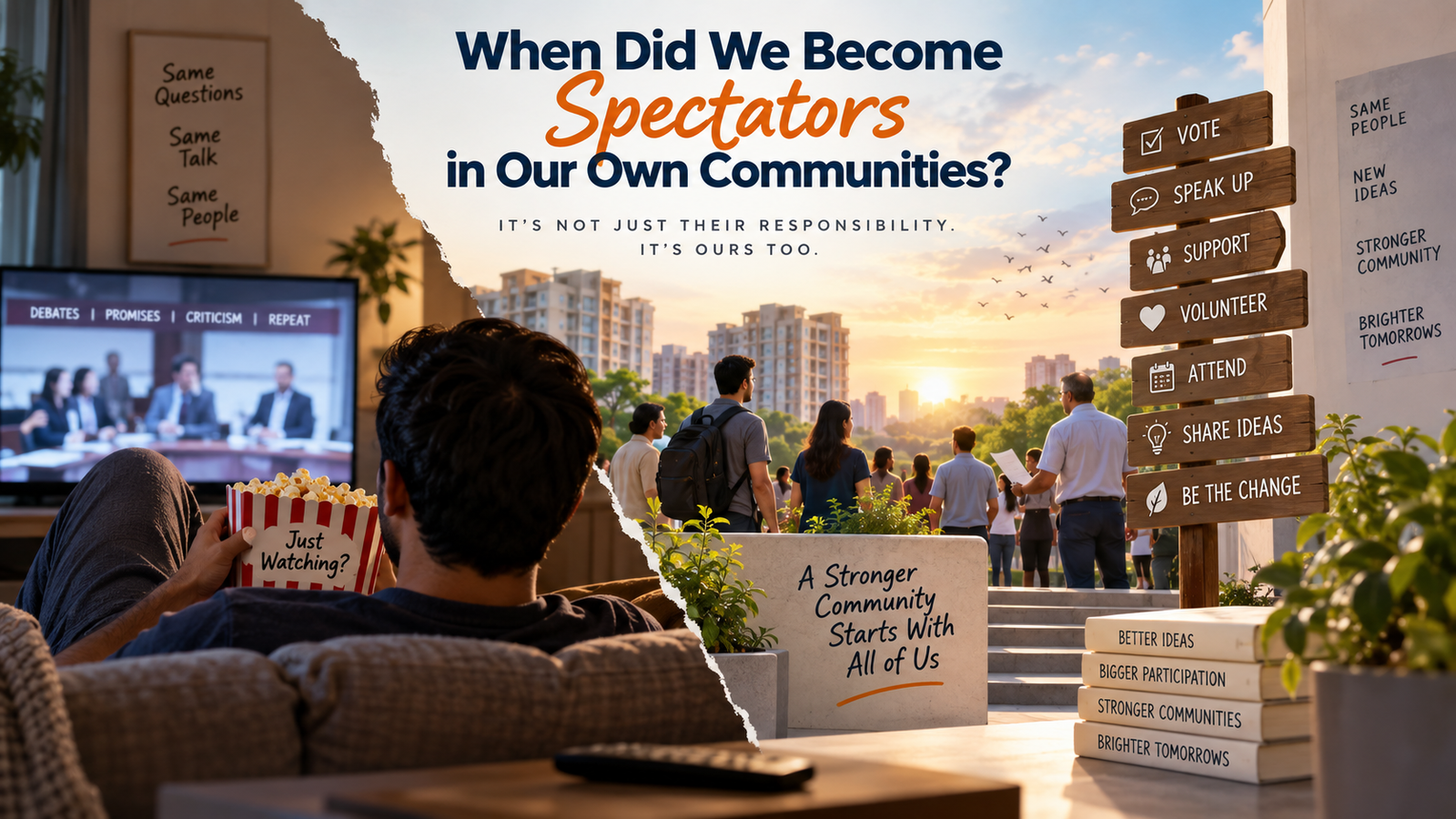
It reminds me of watching a cricket match from the comfort of our couch. We have the popcorn, the air-conditioning and the perfect camera angle. From there, it is incredibly easy to explain how the batsman should have played the ball.
Except governance isn’t a cricket match.
We aren’t the audience.
We are part of the team.
That distinction matters.
Participation Doesn’t Mean Becoming an Activist
Whenever we talk about public participation, it can sound like we are asking everyone to dedicate their lives to social causes. That is neither realistic nor necessary.
People have jobs, businesses, children, parents, responsibilities and personal lives. Nobody should be expected to attend every meeting or participate in every issue.
But very often, what is actually required of us is remarkably small.
It may simply mean:
- signing a representation after understanding what it says;
- responding to a poll or consultation;
- writing a short email to the relevant authority;
- attending one important meeting;
- spending an hour supporting a genuine community cause;
- volunteering occasionally when your skills can help;
- asking a constructive question;
- sharing useful information; or
- simply standing behind a sensible idea when somebody else has had the courage to propose it.
None of these actions is particularly heroic.
But collectively, they can be extremely powerful.
One person asking a legitimate question can be ignored. Hundreds asking the same question create accountability. One person proposing an improvement has an idea; hundreds supporting it create momentum.
That is the difference between simply having people living together and actually having a community.
Silence Is Not Always Neutral
We often assume that by staying away from an issue, we have chosen neutrality. But silence has consequences too.
Imagine ten people trying to solve a problem that affects a thousand. If the remaining 990 people are completely disengaged, those ten aren’t merely dealing with the original problem anymore. They are also fighting apathy.
Every representation carries less weight. Every initiative becomes harder to sustain. Every volunteer has to work longer. Every person who comes forward begins wondering why they are spending their personal time on something that supposedly matters to everyone.
Eventually, some of them stop.
And then comes the familiar question:
“Why doesn’t anyone come forward anymore?”
Perhaps, occasionally, we should ask a different question:
“What happened the last time somebody did?”
Because coming forward today carries another strange risk — labels.
If someone in power takes an initiative, we suspect an agenda. If someone outside power takes an initiative, we ask why they are interfering. If they support an elected body on a particular issue, they become a “supporter.” If they question that same body tomorrow, they become a “troublemaker.” If they suggest too many ideas, we wonder what they are trying to achieve.
Eventually, the safest option becomes obvious: do nothing.
Don’t suggest. Don’t question. Don’t volunteer. Don’t associate yourself with anything controversial. Don’t put your name on something. Don’t take responsibility.
Because doing nothing rarely attracts criticism.
That may be comfortable for the individual, but it is disastrous for a community. A society in which doing nothing becomes safer than doing something doesn’t necessarily run out of capable people. It teaches capable people to remain silent.
We Cannot Outsource Governance
I think somewhere along the way we have confused representation with outsourcing.
We vote for someone and subconsciously say, “There. We have selected you. Now you take care of everything for the next two years, five years or whatever the term may be. We will return when it is time to judge what you did.”
But democracy was never supposed to work that way.
We need representatives because hundreds, thousands or millions of people cannot collectively execute every administrative decision. Someone has to be entrusted with responsibility and authority.
But representation does not eliminate participation.
There is a fundamental difference between running a system and owning the system. Elected representatives may be entrusted with running it, but collectively, the public still owns it.
And ownership comes with responsibilities.
We should absolutely ask those in power where the money went, why a project was delayed, why a problem wasn’t anticipated, why information wasn’t shared, or why a decision was made. Accountability must remain non-negotiable.
But perhaps another set of questions should accompany those questions.
When somebody sought support for a legitimate cause, did I participate? When my opinion was requested, did I respond? When an important meeting required people to attend, did I make an effort? When somebody proposed something useful, did I examine the idea — or did I first examine who proposed it? When volunteers needed help, did I contribute anything before criticising how they worked?
And perhaps the most uncomfortable one:
Did I participate when participation was easy, or did I arrive only when criticism became easy?
Avatar Is Just a Small Example
Living in a large community like My Home Avatar makes these dynamics particularly visible because everything happens at a scale where we can actually see it.
We know many of the people who contest elections. We know people who volunteer. We know those who raise issues and those who propose solutions. We see discussions happening in our groups. We watch ideas being proposed, debated, supported, criticised and sometimes abandoned.
But this isn’t really an article about Avatar.
Avatar is simply a small laboratory where a much larger human behaviour becomes easier to observe.
Zoom out and the same phenomenon exists almost everywhere — in apartment associations, neighbourhoods, municipalities, cities, states and countries.
The scale changes. The behaviour often doesn’t.
We want better governance. We want better infrastructure. We want transparency. We want efficiency. We want honest representatives. We want responsive institutions.
All perfectly reasonable expectations.
But perhaps there is one more expectation we rarely add to that list:
We need better participation from ourselves.
Support the Idea, Not the Camp
There is one change in behaviour that I believe could dramatically improve public discourse: learn to separate an idea from the person proposing it.
If an idea is good, support it.
If it has flaws, question it.
If it can be improved, improve it.
If evidence shows that it is wrong, oppose it.
But don’t begin with, “Who proposed this?”
Once every community issue is viewed through panels, camps, political affiliations, friendships and personalities, even simple improvements become political contests. People stop discussing whether an idea will work and start discussing which side will receive the credit.
That is when governance becomes unnecessarily toxic.
Supporting one good proposal from someone does not mean you have surrendered your right to disagree with their next proposal. Similarly, questioning a decision does not automatically make someone an opponent.
We should be capable of saying, “I agree with you on this,” today and “I disagree with you on that,” tomorrow without needing to change camps in between.
Sometimes there shouldn’t be a camp at all.
Sometimes the only side worth taking is the side of the issue.
I Am Part of This Problem Too
It would be very easy to write everything above as advice to everybody else.
That would also make it hypocritical.
I am no different.
There have certainly been issues where I could have participated more. Messages I could have responded to. Meetings I could have attended. People I could have encouraged. Causes where I probably thought exactly what everyone else thinks:
“Someone will take care of it.”
And very often, someone did.
That conveniently allowed me to continue with my life while somebody else spent their time solving something that benefited me too.
So I am not writing this from a pedestal. I am writing it as much for myself as for anybody reading it.
Maybe that is where change actually has to begin.
Not with another lecture about what governments, committees, elected representatives or “other people” should do differently.
With a little introspection about what I can do differently.
A Different Resolution for 2027
Every new year, we make familiar resolutions. Exercise more. Eat better. Save more. Travel more. Spend more time with family.
Perhaps 2027 deserves another one:
Participate a little more.
Not by becoming a full-time activist. Not by contesting an election. Not by spending every evening arguing in WhatsApp groups. And certainly not by blindly supporting whoever happens to be in power.
Just participate.
When something worthwhile requires a signature, understand it and sign it.
When your opinion is genuinely sought, give it.
When an important cause needs people to physically show up, try to be there.
When somebody proposes a sensible idea, don’t leave them standing alone merely because supporting the idea might cause someone to associate you with the person.
When elected representatives do something good, acknowledge it. When they don’t, question them constructively.
When somebody outside the system comes forward with an idea, judge the idea before trying to guess their motive.
And every once in a while, instead of asking:
“Why isn’t somebody doing something?”
perhaps ask:
“Is there something small I can do?”
Because change doesn’t always need heroes.
It needs ordinary people willing to do small things consistently.
A signature. An email. An hour. A vote. A suggestion. A meeting. A question. A voice saying, “This makes sense. I support it.”
Individually, none of these sounds revolutionary.
Multiply them by hundreds, thousands or millions of people, and they become something very powerful.
They become participation.
I will continue expecting elected representatives — whether in my residential community or in public government — to perform the responsibilities they voluntarily accepted. They should be questioned. They should be accountable. They should work transparently and efficiently.
But going into 2027, I want to add another expectation.
An expectation of myself.
Perhaps we have spent too much time asking what the people in power need to change while quietly excluding ourselves from the equation.
So my wish for 2027 isn’t merely that we get better leaders, better committees, better governments or better systems.
My wish is that we become better participants.
That includes me.
Because ultimately, the quality of a democracy, a city, a neighbourhood or even a residential community cannot be determined only by the handful of people sitting at the table.
It is also shaped by what everyone outside that room chooses to do.
We can sit comfortably on our couches, popcorn in hand, watching a handful of people attempt to solve problems that belong to all of us.
Or occasionally, we can put the popcorn aside and participate.
Those in power have a responsibility to serve.
The public has a responsibility to participate.
Good governance needs both.